
- This event has passed.
World Tessellation Day
June 17, 2025
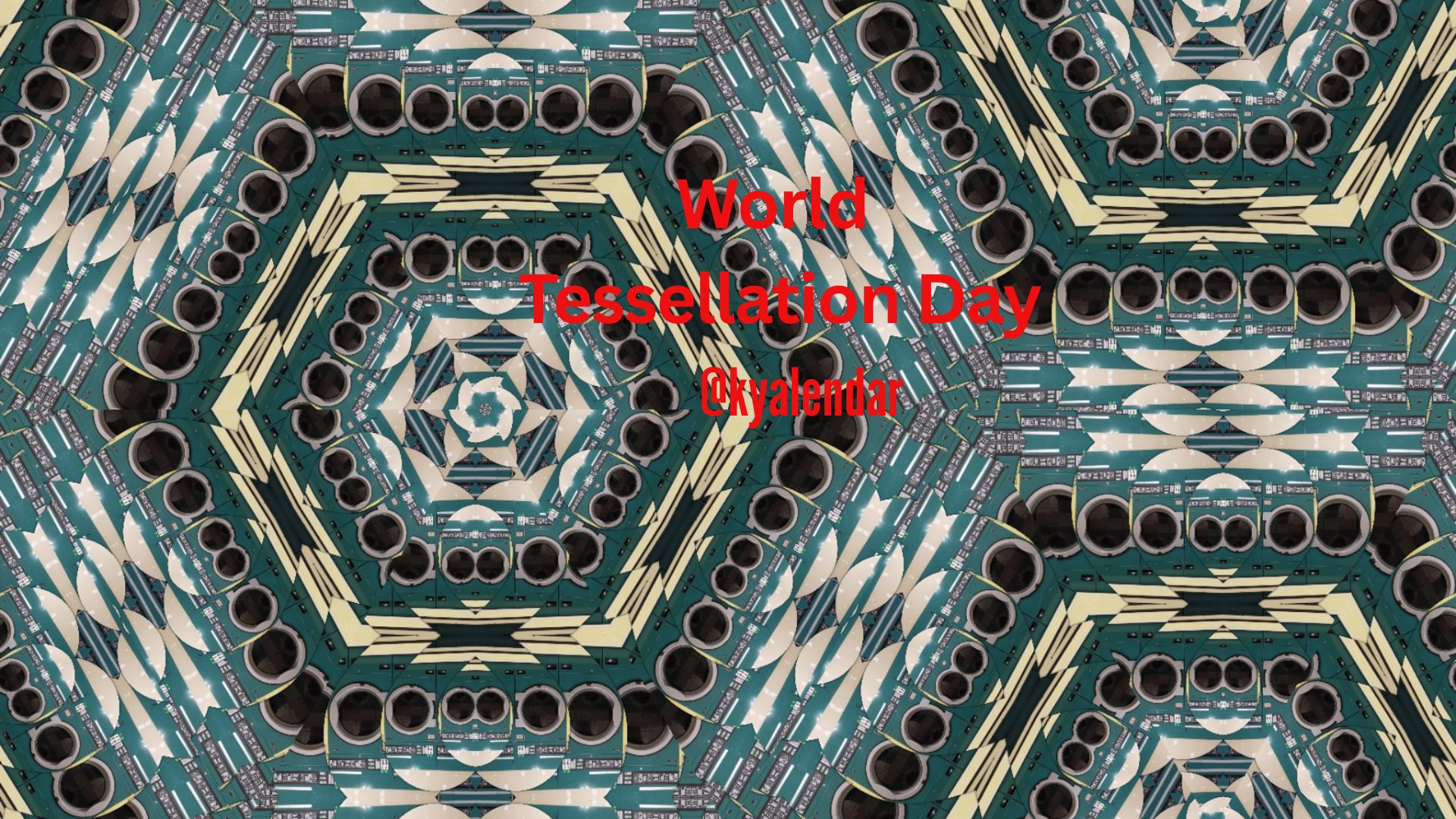
World Tessellation Day is celebrated annually on 17th June, honouring the art and beauty of tessellations—repeating geometric patterns that perfectly cover a surface without any gaps or overlaps. This day is a chance to explore and appreciate the fascinating world of shapes and their unique mathematical and artistic significance. Inspired by the work of Dutch graphic artist M.C. Escher, who is famous for his complex tessellated artworks, the day encourages individuals, schools, and art enthusiasts to engage with tessellations in various creative forms.
What is a Tessellation?
A tessellation, also known as tiling, is created when a shape is repeated over and over again, fitting together perfectly without leaving any gaps. There are numerous types of tessellations, ranging from simple ones that use regular shapes like squares or triangles to complex, more intricate designs. Tessellations are not only a beautiful artistic concept but also a key part of geometry, appearing in both nature and human-made objects. Examples can be found in honeycomb patterns, tiled floors, and even molecular structures.
The Importance of Tessellations in Art and Mathematics
Tessellations have been an integral part of human history, particularly in architecture, art, and science. The ancient Romans used tessellation techniques in their mosaics, and Islamic art frequently features tessellated designs in tiles and walls, which were symbolic of infinity and the divine.
In mathematics, tessellations help illustrate concepts related to symmetry, geometry, and spatial reasoning. Understanding how shapes fit together is key in fields like architecture, engineering, and computer graphics. Tessellations also serve as the basis for understanding higher-level concepts such as fractals and dimensional tiling.
M.C. Escher is perhaps the most recognised figure associated with tessellations in modern art. His work plays with geometric shapes and impossible constructions, often featuring animals, people, or other figures that seamlessly transform into one another in hypnotic, repeated patterns. Escher’s pieces demonstrate the balance between art and mathematics, making tessellations accessible and intriguing to a wide audience.
Ways to Celebrate World Tessellation Day
World Tessellation Day offers a variety of creative ways to celebrate and engage with this fascinating concept:
- Create Your Own Tessellation: Whether you’re an artist or a beginner, designing your own tessellation can be a fun and educational experience. Start with simple shapes like squares or triangles, and gradually move toward more complex designs.
- Learn About Escher’s Work: Take the day to dive into the world of M.C. Escher’s tessellated artworks. Explore how he combined art and mathematics to create mesmerising patterns and illusions.
- Explore Tessellations in Nature: From the scales on a fish to the hexagonal structure of a beehive, tessellations appear naturally all around us. Use World Tessellation Day as an opportunity to explore and appreciate these natural patterns.
- Incorporate Tessellations into Your Art: Whether you’re a painter, graphic designer, or textile artist, tessellations can add a new layer of depth and structure to your work. Experiment with different shapes and designs to create visually stunning pieces.
- Mathematical Challenges: If you’re more mathematically inclined, take on the challenge of discovering new tessellation patterns. This could involve experimenting with regular, semi-regular, or non-regular shapes to see how they fit together.
- Host Tessellation Workshops: Schools, community centres, and art studios can organise tessellation workshops to introduce people to the concept. It’s a fun and educational way to engage with geometry, art, and design, making it an excellent activity for all ages.
- Tessellation Puzzles: Another enjoyable way to celebrate is by solving or creating tessellation-based puzzles. This could include jigsaw puzzles featuring tessellated designs or digital games where players must fit shapes together perfectly.
The Broader Impact of Tessellations
Tessellations go beyond just being aesthetically pleasing patterns; they have real-world applications in fields such as physics, chemistry, biology, and even data encryption. The way molecules bond and the structures they form often reflect tessellated patterns, making tessellations a critical part of understanding material science.
In architecture and construction, tessellations are used to design floor tiles, brickwork, and other structural elements that need to fit together seamlessly. Even in technology, tessellation algorithms are used in computer graphics to render complex shapes and textures more efficiently.
In the natural world, tessellations help organisms maximise space and resources. For instance, the hexagonal cells of a beehive allow bees to use the least amount of wax while storing the maximum amount of honey.
The Educational Value of Tessellations
Teaching tessellations in schools can enhance students’ understanding of both art and mathematics. By engaging with tessellated designs, students learn about symmetry, geometry, and the relationships between shapes. This hands-on approach helps demystify mathematical concepts and makes learning more interactive and enjoyable.
Teachers can incorporate tessellation activities into art lessons or mathematics classes, allowing students to create their own patterns while learning about the underlying principles. World Tessellation Day serves as an ideal opportunity to introduce this concept to younger learners, fostering creativity and critical thinking in the process.
Conclusion
World Tessellation Day is a celebration of both the beauty and the functionality of repeating patterns. Whether viewed through the lens of art or mathematics, tessellations offer a unique way to explore the interconnectedness of shapes and structures in the world around us. By taking part in this day, we not only appreciate the artistic value of tessellations but also their significant impact on various scientific and architectural fields.
Celebrating World Tessellation Day can be as simple as admiring the tiled floor beneath your feet, or as involved as creating your own complex tessellated design. No matter how you choose to observe the day, it’s an opportunity to recognise the harmony between art and mathematics, and to see the world in patterns, symmetry, and endless possibilities.